
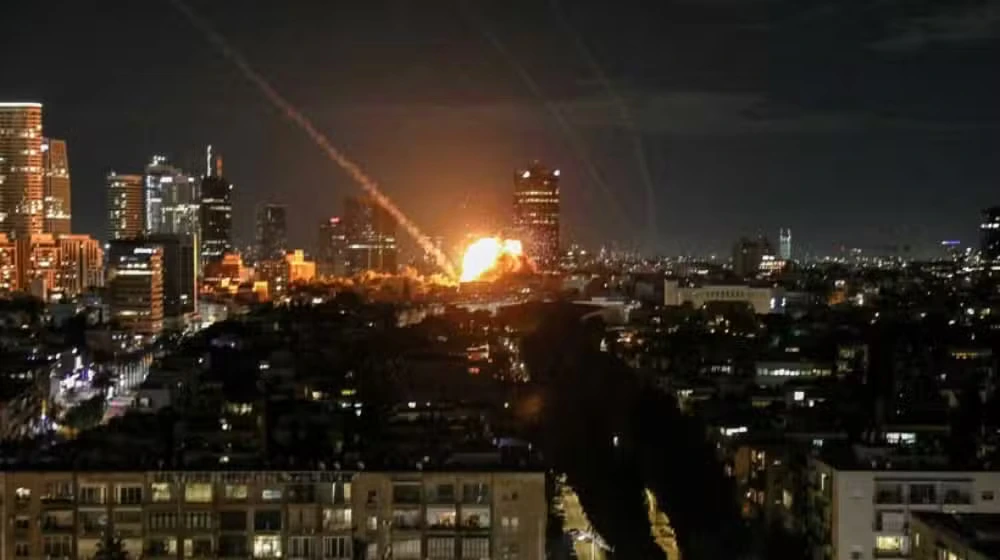
What Are Iran’s Cluster Missiles Challenging Israel’s Defenses?
Iran has been firing ballistic missiles equipped with cluster munitions at Israel since the US-Israel joint attack on Iran began on February 28, 2026 — and nearly half of all 300 missiles launched so far carry these bomblets, which split into dozens of smaller explosives mid-air and rain down across miles of civilian areas. The weapon has exposed a critical gap in Israel’s celebrated multi-layered air defense system.
Quick Facts
- Nearly 50% of Iran’s 300 missiles fired at Israel since February 28, 2026 carry cluster warheads, per Israeli military officials
- Each missile carries 24 to 80 bomblets, each containing 2–5 kg of explosives
- Bomblets disperse at 7–10 km altitude across a radius of up to 10 kilometres
- The Khorramshahr missile — Iran’s most advanced variant — can carry up to 80 bomblets
- Iran first used cluster missiles publicly in June 2025 during the 12-day Israel-Iran war
What Exactly Is a Cluster Munition?
A cluster munition is a weapon that releases dozens of smaller sub-munitions — called bomblets — from a single missile. Iran’s ballistic missiles are fitted with a cargo warhead that opens at high altitude, scattering these bomblets over a wide area before they fall to the ground.
According to Reuters, Iranian cluster warheads carry approximately 24 submunitions, each containing 2 to 5 kg of explosives. The bomblets break apart at altitudes of 7 to 10 km, creating dozens of separate impact sites across a radius of up to 10 km. The Khorramshahr — Iran’s most capable ballistic missile — can be equipped with up to 80 bomblets, according to weapons experts cited by CNN.
The same Iran-Israel conflict that is driving global crude oil prices above $100 per barrel and straining Pakistan’s fuel subsidy budget is now escalating on the missile front.
Why Are These Missiles So Hard to Intercept?
Israel’s air defense system — which includes the Arrow-3 for long-range ballistic missiles, David’s Sling for medium-range threats, and Iron Dome for short-range rockets — is designed to intercept whole missiles before impact. Cluster munitions break that logic entirely.
“It’s a mechanism to bypass active missile defense,” said Tal Inbar, a missile expert who consults for Israeli defense companies, speaking to CNN. In some cases, Israel’s Arrow-3 interceptors successfully hit the incoming missile — but the bomblets have already been released at altitude and continue falling regardless.
Iron Dome can attempt to intercept individual bomblets, but their small size and high descent speed make interceptions inconsistent. According to Al Jazeera, military analyst Elijah Magnier described the warheads as converting “individual ballistic missiles into broader, operationally harder-to-defend threats against multilayered air defence architectures.”
The Human Cost on the Ground
On March 17, 2026, Iran fired cluster missiles at the Ramat Gan area near Tel Aviv in retaliation for Israel’s assassination of Iranian security chief Ali Larijani. A couple in their 70s was killed in their apartment by a single bomblet — they were just outside their safe room when it struck, according to Reuters.
A CNN analysis of two separate cluster attacks confirmed impact sites spread across areas of seven and eight miles respectively — striking car washes, residential blocks, parks, and a children’s playground in Rishon LeZion. Unexploded bomblets also remain a long-term danger; Israel’s Home Front Command has instructed citizens not to approach any unexploded munitions on the ground.
Iran’s Strategic Logic Behind Cluster Weapons
Iran’s use of cluster munitions serves two goals beyond raw destruction. First, it forces Israel and the US to fire multiple costly interceptors against a single incoming missile — depleting a finite stock. Second, it maximises psychological pressure by triggering nationwide shelter alerts and spreading civilian fear across wide urban areas.
“The ongoing use of such munitions is likely intended to have a primarily suppressive and psychological effect,” said N.R. Jenzen-Jones, Director of Armament Research Services, speaking to CNN. Iran first demonstrated this cluster warhead capability publicly in June 2025 and has now made it a deliberate, integrated part of its missile strategy, according to Al Jazeera’s military analysis.
Cluster munitions are banned under the 2008 Convention on Cluster Munitions, signed by 111 countries — but neither Iran, Israel, nor the United States is a signatory to the treaty.
What Comes Next
Defence analysts at the Foundation for Defense of Democracies have urged Washington and Jerusalem to urgently expand production of Arrow-3 interceptors and associated radar systems to counter the cluster warhead threat before Iran’s missile inventory is further depleted by US-Israeli strikes. Yehoshua Kalisky, a senior researcher at the Institute for National Security Studies at Tel Aviv University, noted that most Iranian missiles are still being intercepted by Arrow-3 — but the system was never designed with cluster munitions in mind.
Iran’s missile programme — the largest in the Middle East — has evolved from brute-force barrages to a precision psychological and attrition strategy. Cluster warheads are its sharpest edge against an Israeli defense system that, for all its sophistication, cannot stop what it cannot catch intact.
Frequently Asked Questions
Q: What are Iran’s cluster missiles? A: Iran’s cluster missiles are ballistic weapons fitted with cargo warheads that release 24 to 80 smaller bomblets at altitudes of 7–10 km. Each bomblet carries 2–5 kg of explosives and falls across a radius of up to 10 km. The Khorramshahr is Iran’s most powerful cluster-capable missile, carrying up to 80 bomblets.
Q: Why can’t Israel’s Iron Dome stop Iran’s cluster missiles? A: Iron Dome is designed for short-range rockets, not high-altitude ballistic missiles. When Iran’s missiles release bomblets at 7–10 km altitude, the dozens of small, fast-falling sub-munitions overwhelm interception systems. Even a successful Arrow-3 hit may not stop already-released bomblets.
Q: How many cluster missiles has Iran fired at Israel in 2026? A: By March 25, 2026, Iran had fired approximately 300 missiles at Israel since the war began on February 28, 2026. Israeli military officials confirmed that nearly half — around 150 — were equipped with cluster munitions, according to Reuters and CNN.
Q: Are cluster bombs legal under international law? A: Cluster munitions are prohibited under the 2008 Convention on Cluster Munitions, ratified by 111 countries. However, Iran, Israel, and the United States have not signed the convention, meaning none of the three parties are legally bound by the ban.
Q: What is Iran’s Khorramshahr missile? A: The Khorramshahr is Iran’s most advanced medium-range ballistic missile, capable of carrying up to 80 cluster bomblets in its warhead. It is part of Iran’s broader ballistic missile programme — the Middle East’s largest — which also includes the Shahab-3, Emad, Kheibar Shekan, and Sejjil systems.