
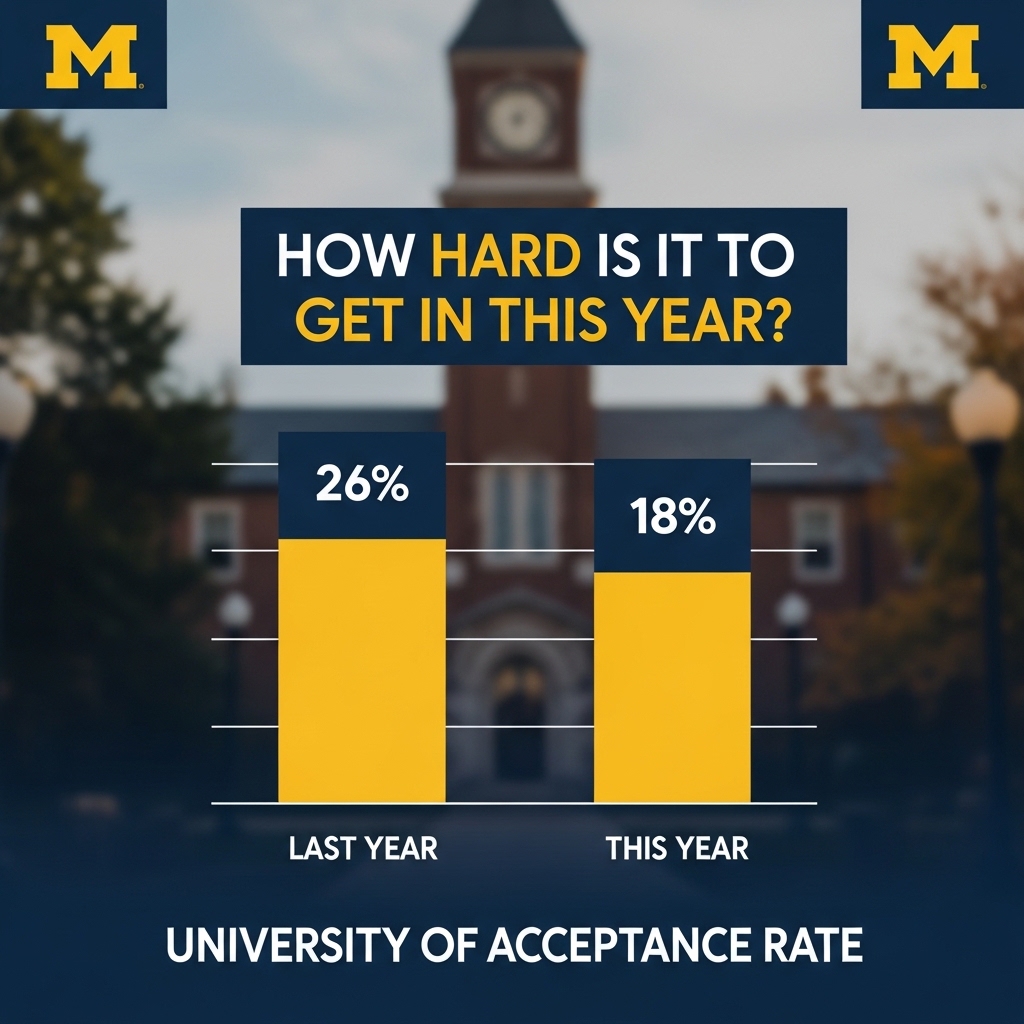
university of michigan acceptance rate How Hard is it to get in this year
University of Michigan Acceptance Rate 2026 – UMich Admissions Guide
UMich went from a 42% acceptance rate in 2010 to just 15.6% for the Class of 2028 — and with a record 109,000 applications for Class of 2029, it keeps getting harder. Here is every number, comparison, and strategy you need to get into Michigan.
The University of Michigan acceptance rate stands at 15.6% for the Class of 2028 — down from 26% just five years ago and a staggering drop from 42% in 2010. For the Class of 2029, UMich received a record-breaking 109,000 applications — an 11% jump over the prior year and a 36% surge over five years — while the number of available spots stayed flat at roughly 15,000–16,000. This means the calculated acceptance rate for Class of 2029 has dropped to approximately 16.4%. UMich is now ranked the #3 best public university in the U.S. by U.S. News, and its admissions profile increasingly resembles an elite private institution.
- Overall Acceptance Rate — Year by Year
- In-State vs. Out-of-State Acceptance Rate
- Early Action Acceptance Rate
- Transfer Acceptance Rate
- Waitlist Acceptance Rate
- International Students
- Acceptance Rate by Program
- Michigan Law School Acceptance Rate
- Michigan Ross MBA Acceptance Rate
- Admitted Student Profile
- UMich Application Timeline
- UMich vs. UVA vs. UNC Comparison
- Tips to Get Admitted
- FAQs
University of Michigan Acceptance Rate — Year by Year
The University of Michigan acceptance rate has been on a steep downward trajectory for over a decade. Here is the complete historical picture — one of the most dramatic selectivity transformations at any public university in the country:
| Class Year | Acceptance Rate | Applications | Admitted |
|---|---|---|---|
| Class of 2024 (2020) | 26.1% | 65,022 | ~16,974 |
| Class of 2025 (2021) | 20.2% | ~68,000 | ~13,736 |
| Class of 2026 (2022) | 17.7% | ~80,000 | ~14,160 |
| Class of 2027 (2023) | 17.9% | ~88,000 | ~15,752 |
| Class of 2028 (2024) | 15.6% | 98,310 | 15,373 |
| Class of 2029 (2025 — Latest) | ~16.4%* | 109,000 | ~17,915 |
*Class of 2029 estimated rate based on ~109,000 applications and ~17,915 admitted students (AdmitStudio data). Official UMich Common Data Set not yet released. Source: AdmissionSight, AdmitStudio, UMich Record.
UMich In-State vs. Out-of-State Acceptance Rate
Like all flagship public universities, Michigan’s acceptance rate is dramatically different depending on where you live. The University of Michigan out-of-state acceptance rate is one of the most important — and most misunderstood — numbers in UMich admissions.
In-State
Michigan Residents — Acceptance Rate ~39–40%
In-state Michigan residents enjoy a significantly higher acceptance rate of approximately 39–40%. UMich has a legal and historical obligation to serve Michigan residents first. However, the in-state rate has also fallen sharply — it was above 50% a decade ago. Even for Michigan students, a strong application is no longer optional. Roughly half of UMich’s undergraduate student body is now non-Michigan residents — a major shift from a decade ago when 64% were Michigan natives.
Out-of-State
Out-of-State Applicants — Acceptance Rate ~15–18%
Out-of-state applicants face an acceptance rate of approximately 15–18% — making UMich one of the most competitive options in the country for non-residents. At this level, UMich rivals many elite private universities. Out-of-state applicants need SAT scores above 1400, a GPA above 3.75, strong extracurriculars, and compelling essays to be competitive. If scores are below 1400 (SAT) or 31 (ACT), UMich’s test-optional policy means omitting them may be the better strategy.
University of Michigan Early Action Acceptance Rate
UMich offers a non-binding Early Action (EA) program — not Early Decision. This is a major strategic tool for applicants: applying EA gives you a better chance of admission while keeping your options open at other schools.
Nov 1 Deadline
Early Action — ~22–26% Acceptance Rate
The UMich Early Action acceptance rate typically runs approximately 22–26% — significantly higher than the overall 15.6% rate. EA applicants benefit from less competition (fewer applicants in the pool) and demonstrate strong interest in Michigan. EA decisions are released in late January. Because EA is non-binding, you can apply to as many other schools as you want simultaneously. Applying EA is strongly recommended for all applicants — both in-state and out-of-state.
Decision
Regular Decision — Significantly More Competitive
The Regular Decision deadline is February 1, with notifications in late March. By the time RD applications are reviewed, UMich has already filled a significant portion of its class through EA. RD applicants face the most competitive pool and must have an excellent application profile. Deferral is common in EA — UMich typically defers 25–30% of EA applicants to RD, and only about 10–15% of deferred students are ultimately admitted in the RD round.
University of Michigan Transfer Acceptance Rate
The University of Michigan transfer acceptance rate is considerably more accessible than freshman admissions — but it has also grown more selective. Here is the full picture:
| Class Year | Transfer Acceptance Rate | Applicants | Admitted |
|---|---|---|---|
| Class of 2025 | 45.8% (highest) | 4,271 | 1,956 |
| Class of 2026 | ~38% | ~5,000 | ~1,900 |
| Class of 2027 | 34.5% | ~5,500 | ~1,898 |
| Class of 2028 (Latest) | 34.5% | 6,832 | 2,358 |
| Fall 2024 (Enrolled) | 35% | 6,832 | 2,385 |
Source: AdmissionSight, College Transitions. Transfer acceptance rate is nearly double the freshman rate — making transfer a viable pathway to UMich.
The UMich transfer acceptance rate of 34.5–35% is nearly double the freshman acceptance rate, making transfer admission a genuinely viable pathway. Transfer applicants should have a strong college GPA (3.5+ recommended), completed prerequisite coursework for their intended major, and a compelling explanation of why UMich is the right fit for their academic goals. Also compare the Rutgers University transfer acceptance rate if you are weighing multiple options.
University of Michigan Waitlist Acceptance Rate
Waitlist (2027)
Waitlist Acceptance Rate — Volatile but Real
UMich’s waitlist acceptance rate is volatile — it swings dramatically year to year based on yield. For the Class of 2027, 26,898 students were waitlisted and 18,321 accepted a spot, but only 955 were admitted — a 3.6% waitlist acceptance rate. For Classes of 2025 and 2026, rates were 0.4% (just 68–77 students admitted). However, historically UMich turns to its waitlist 77% of the time and has admitted as many as 1,248 students off the waitlist in a single year (Class of 2025, during COVID). The waitlist at UMich is genuinely active — unlike some schools where it functions as a soft rejection.
University of Michigan International Student Acceptance Rate
International students face acceptance rates generally comparable to overall rates — approximately ~18% based on available data. UMich is home to over 8,000 international students from more than 120 countries. For the Class of 2029, approximately 8% of admitted students are international, representing countries including China, India, South Korea, Canada, Indonesia, Hong Kong, Singapore, and Japan. International undergraduate enrollment (Fall 2024) exceeded 2,700 students. International applications surged as part of the 109,000-application record for Class of 2029.
University of Michigan Acceptance Rate by Program
Acceptance rates vary significantly across UMich’s 19 schools and colleges. The most competitive programs — engineering, Ross business, computer science, and nursing — have acceptance rates well below the overall university figure:
Michigan Law School (JD)
8.57% acceptance rate. 8,982 applicants, 770 admitted, 329 enrolled. Median LSAT: 171. Median GPA: 3.88. Ranked #10 nationally. First-time bar passage: 95.57%.
College of Engineering
Significantly more competitive than UMich’s overall rate. Mid-50% SAT for engineering admits trends toward the 75th percentile (1530+). CS and electrical engineering most competitive.
Ross School of Business (BBA)
Ross is a First-Year Admitting Unit (since 2024) — students must indicate Ross interest on the Common App. Average admitted GPA: 3.94. Average SAT: 1470. ACT: 33.
All Freshman Applicants
15.6% overall (Class of 2028). In-state: ~39%. Out-of-state: ~15–18%. Mid-50% SAT: 1360–1530. Mid-50% ACT: 31–34.
Michigan Ross MBA
~29–30% acceptance rate. Average GMAT: 731. Average GPA: 3.43. Average work experience: 5.8 years. Ranked #12 nationally by U.S. News.
Transfer Applicants
34.5–35% transfer acceptance rate — nearly double the freshman rate. 6,832 applicants, 2,358–2,385 admitted for latest cycle.
Michigan Law School Acceptance Rate
The University of Michigan Law School acceptance rate is 8.57% — making it one of the most selective law schools in the United States and a consistent top-10 program nationally. Here are the complete statistics:
| Metric | Michigan Law (2025 ABA 509) |
|---|---|
| Acceptance Rate | 8.57% |
| Applications Received | 8,982 |
| Offers of Admission | 770 |
| Enrolled (1L Class) | 329 (target 300–320) |
| Median LSAT | 171 |
| 25th–75th LSAT Range | 168–173 |
| Median Undergraduate GPA | 3.88 |
| 25th–75th GPA Range | 3.74–3.95 |
| In-State Tuition | ~$76,680/year |
| Out-of-State Tuition | ~$79,680/year |
| Yield Rate | 42.73% |
| First-Time Bar Passage (2024) | 95.57% |
| Ultimate Bar Passage (2022) | 98.7% |
| U.S. News Ranking | #10 National Law Schools |
| Early Decision Deadline | November 15 |
| Regular Decision Deadline | February 28 |
Source: 2025 ABA 509 Report, Michigan Law official admissions page (michigan.law.umich.edu), LSD.Law.
Michigan Ross MBA Acceptance Rate
The Michigan Ross MBA acceptance rate is approximately 29–30%, placing it as one of the more accessible top-15 MBA programs in the country — more competitive than most regional programs, but considerably more accessible than Harvard, Stanford, or Wharton.
| Metric | Ross MBA Class of 2027 |
|---|---|
| Acceptance Rate | ~29–30% |
| Class Size | 379 students |
| Average GMAT Score | 731 |
| GMAT Middle 80% Range | 700–770 |
| Average GRE (Verbal / Quant) | 160 / 163 |
| Average Undergraduate GPA | 3.43 |
| Average Work Experience | 5.8 years |
| Top Pre-MBA Industries | Finance (21%), Consulting (17%), Tech (14%) |
| Median Post-MBA Base Salary | $170,000 |
| Average Signing Bonus | $30,000 |
| In-State Tuition (2025–26) | ~$76,152/year |
| Out-of-State Tuition (2025–26) | ~$81,152/year |
| U.S. News MBA Ranking | #12 National MBA Programs |
| Bloomberg Businessweek Rank | #9 |
Source: Michigan Ross official class profile, Clear Admit, US News. Data reflects Class of 2027.
Admitted Student Profile — UMich Class of 2028 & 2029
| Metric | Class of 2028 / 2029 Data |
|---|---|
| Total Applications (Class of 2029) | ~109,000 (record) |
| Total Admitted (Class of 2029) | ~17,915 |
| Average GPA (Enrolled) | 3.9 |
| Students with GPA ≥ 4.0 | ~39% |
| Students with GPA 3.75–3.99 | ~54% |
| Mid-50% SAT Range | 1360–1530 |
| Mid-50% ACT Range | 31–34 |
| Average SAT Score | 1,470 |
| Students submitting SAT | ~51% |
| Students submitting ACT | ~18–24% |
| International Students (% of class) | ~8% |
| Asian American students | 19.6% |
| Hispanic / Latino students | 9.1% |
| Black / African American students | 4.5% |
| Multiracial students | ~5.5% |
| Yield Rate | 47.3% |
| NCAA Division I athletes | 900+ student-athletes, 29 sports |
UMich uses a holistic admissions process that considers academic performance, extracurricular activities, essays, and letters of recommendation. It is test-optional (since 2024), but Michigan “recommends” submitting scores — and for out-of-state applicants especially, strong test scores provide a meaningful advantage. Only about 1% of enrolled students had a GPA below 3.74 — meaning academic excellence is the floor, not the ceiling.
UMich Application Timeline — Key Dates
Common App Opens — Begin Your Application
UMich accepts the Common Application. Begin your essays and short-answer responses in summer. UMich requires several short-answer questions in addition to the Common App essay — start early.
Early Action Deadline — Strongly Recommended
Non-binding Early Action deadline. EA acceptance rate (~22–26%) is significantly higher than the overall 15.6%. EA is open to all students regardless of state of residence. Ross (BBA), Engineering, and other direct-admit programs all require EA or RD selection on the Common App.
Early Action Decisions Released
EA decisions released. Admitted students have until May 1 to decide. Deferred students (25–30% of EA applicants) are automatically reviewed in Regular Decision — submit an Expression of Continued Interest to maximize your chances.
Regular Decision Deadline
Final deadline for freshman applications. Fewer spots remain after EA round. RD applicants compete in the most congested pool — a strong application profile is essential.
Regular Decision Notifications
All RD decisions released. Waitlist notifications also go out in March–April. Students have until May 1 to confirm enrollment.
National Decision Day — Enroll or Decline
Final deadline to submit enrollment deposit. UMich’s yield rate has climbed to 47.3% — far above the national average for public universities — reflecting the school’s growing desirability. Waitlist decisions come in May–July depending on yield.
| Date | Event | Notes |
|---|---|---|
| Aug 1 | Common App Opens | UMich requires supplemental short answers |
| Nov 1 | Early Action Deadline | ~22–26% EA acceptance rate; non-binding |
| Nov 15 | Michigan Law Early Decision | Law school only — binding ED |
| Late January | EA Decisions Released | Deferred students get Expression of Interest form |
| Feb 1 | Regular Decision Deadline | Freshman applications close |
| Feb 28 | Michigan Law RD Deadline | Law school regular decision deadline |
| Late March | RD Decisions Released | Waitlist notifications also sent |
| May 1 | National Decision Day | Enrollment deposit deadline |
Source: UMich Office of Admissions (admissions.umich.edu), Michigan Law admissions page.
UMich vs. UVA vs. UNC — Public University Acceptance Rate Comparison
| University | Overall Rate | In-State Rate | Out-of-State Rate | US News Public Rank |
|---|---|---|---|---|
| Univ. of Michigan | ~16.4% | ~39% | ~15–18% | #3 |
| Univ. of Virginia (UVA) | ~17% | ~24% | ~14% | #4 |
| UNC-Chapel Hill | ~17% | ~22% | ~12% | #5 |
| UC Berkeley | ~11% | ~14% | ~7% | #1 |
| Michigan State (MSU) | ~71% | Higher | Lower | — |
UMich’s overall acceptance rate (~16%) is slightly higher than UNC and UVA, but the in-state advantage at UMich (39%) is considerably larger than at UVA (24%) or UNC (22%). For out-of-state applicants, all three flagship universities are brutally competitive. Michigan State University (MSU), which is often confused with UMich, has an acceptance rate of ~71% — a dramatically different institution.
7 Tips to Improve Your University of Michigan Admission Chances
Apply Early Action — It Is the Single Most Impactful Decision
The UMich Early Action acceptance rate of ~22–26% vs. the overall 15.6% rate means EA applicants have a meaningfully better shot. EA is non-binding — there is zero cost to applying by November 1 instead of February 1. This is the most important strategic decision any UMich applicant can make.
Target a 3.9+ GPA Through Rigorous Coursework
Among enrolled students, 39% had a 4.0+ GPA and 54% had a GPA between 3.75 and 3.99. Only 1% had a GPA below 3.74. Take the most rigorous curriculum your school offers — UMich evaluates course difficulty, not just raw GPA. An “A” in AP Calculus BC reads better than an “A” in regular math.
Submit Strong Test Scores — or Strategically Go Test-Optional
UMich is test-optional since 2024, but “recommends” submitting scores. The mid-50% SAT range is 1360–1530. If your SAT is above 1400 or ACT above 31, submit it — strong scores strengthen your application. If below those thresholds, go test-optional. For out-of-state applicants especially, scores above 1500 (SAT) or 34 (ACT) can meaningfully differentiate you.
Write Outstanding Essays — UMich Reads Every One
UMich requires the Common App essay plus several short-answer supplemental questions. The most common prompt asks why you want to attend Michigan specifically — answer this with specifics: name professors, research labs, programs, or initiatives. Generic “I love Ann Arbor” essays are flagged immediately. UMich’s holistic review means essays carry significant weight when two applicants have similar academic profiles.
Declare a Specific Major — Especially for Ross and Engineering
For Ross (BBA) applicants: since 2024, Ross is a First-Year Admitting Unit — you must declare Ross on the Common App. For Engineering: applying directly to the College of Engineering is more competitive but shows commitment. Applying as LSA (College of Literature, Science & Arts) then trying to switch into a competitive program is harder than direct admission, especially for CS and engineering.
Develop Leadership in Extracurriculars — Depth Beats Breadth
UMich looks for applicants who have made a genuine impact, not just participated in many clubs. Founded a club, led a team to a state championship, published research, started a business — these are the extracurriculars that stand out. Show 1–2 deep commitments rather than 10 surface-level activities.
Out-of-State? Make Your Case Specifically for Michigan
With a 15–18% out-of-state acceptance rate, non-residents must work harder to justify why UMich — not a closer state flagship — is right for them. Reference specific UMich resources: the Michigan Research Community, specific professors, interdisciplinary programs, or Ann Arbor’s startup ecosystem. Show you have researched Michigan specifically, not just “a good university.”
Frequently Asked Questions
Final Thoughts — University of Michigan Acceptance Rate 2025
The University of Michigan acceptance rate of 15.6% tells you that UMich has crossed into elite territory — but the story is more nuanced than the headline. Michigan residents face a 39% rate at one of America’s finest public universities. Out-of-state applicants face 15–18% and must treat UMich like a selective private institution. The most powerful strategic levers: apply Early Action by November 1, build a 3.9+ GPA through rigorous courses, write specific and compelling essays about why Michigan fits your exact goals, and — for law school applicants — target a 171 LSAT and 3.88 GPA for the #10-ranked Michigan Law program. Go Blue.