

Best Workout Routines: Your Complete Guide to Building Strength and Muscle
Finding the right workout routine can transform your fitness journey. Whether you’re stepping into a gym for the first time or looking to optimize your training for specific goals, understanding the fundamentals of effective workout programming is essential. This comprehensive guide breaks down the best workout routines for different experience levels and objectives, helping you build a plan that delivers real results.
Best Workout Routine: Core Principles That Work
Before diving into specific programs, let’s establish what makes a workout routine effective. The best workout routine isn’t necessarily the most complex or the one requiring the most time in the gym. Instead, it’s built on several key principles that drive progress regardless of your experience level.
Progressive Overload
Your body adapts to stress by getting stronger. Progressive overload means gradually increasing the difficulty of your workouts over time. This could involve adding weight, increasing reps, slowing down the tempo, or improving the depth of your movements. Without progressive overload, your muscles have no reason to grow or get stronger.
Consistency Over Intensity
Training three to four times per week consistently will always outperform sporadic intense sessions. Your muscles need regular stimulation to adapt and grow. Most muscle groups should be worked at least twice weekly for optimal development.
Adequate Recovery
Muscle growth happens during rest, not during workouts. Training creates microscopic tears in muscle fibers, and these repair and rebuild during recovery periods. This means rest days aren’t optional they’re when the actual gains happen. Most effective routines include at least one full rest day per week.
Proper Volume and Intensity
For muscle growth and strength, aim for three to four sets of eight to twelve reps per exercise. The weight should be challenging enough that the last few reps are difficult but still achievable with good form.
Comparison of Training Frequencies
| Training Days/Week | Best For | Muscle Group Frequency | Example Split |
| 2-3 days | Beginners, maintenance | Full body 2x/week | Full body routine |
| 4 days | Muscle gain, balance | Each group 2x/week | Upper/Lower split |
| 5-6 days | Advanced muscle gain | Each group 2x/week | Push/Pull/Legs |
Best Workout Routine for Beginners
Starting your fitness journey requires a different approach than advanced training. The best workout routine for beginners focuses on learning proper form, building foundational strength, and establishing consistent habits without overwhelming your body.
Read More About Baber Azam
Why Full Body Workouts Work Best
When you’re new to training, full body workouts two to three times per week provide optimal results. This approach allows you to practice each movement pattern multiple times weekly while giving muscles adequate recovery between sessions.
Beginner Full Body Routine (3 Days/Week)
Workout A:
- Goblet Squats: 3 sets of 10-12 reps
- Push-ups (or Knee Push-ups): 3 sets of 8-12 reps
- Dumbbell Bent Over Rows: 3 sets of 10-12 reps
- Dumbbell Shoulder Press: 3 sets of 10-12 reps
- Plank: 3 sets of 20-30 seconds
Workout B:
- Leg Press: 3 sets of 10-12 reps
- Dumbbell Chest Press: 3 sets of 10-12 reps
- Lat Pulldowns: 3 sets of 10-12 reps
- Dumbbell Lateral Raises: 3 sets of 12-15 reps
- Dead Bug: 3 sets of 10 reps per side
Alternate between Workout A and Workout B, training three non-consecutive days per week. For example, Monday (A), Wednesday (B), Friday (A), then the following week Monday (B), Wednesday (A), Friday (B).
Equipment Recommendations
Resistance machines are ideal for beginners because they follow a fixed movement path, making it easier to perform exercises correctly while minimizing injury risk. As you become comfortable with the movements, you can transition to free weights like dumbbells and barbells, which engage more stabilizing muscles and build functional strength.
Common Beginner Mistakes to Avoid
- Training every day without rest
- Using weights that are too heavy and compromising form
- Skipping warm-ups and cool-downs
- Expecting visible results within the first few weeks
- Neglecting nutrition and protein intake
Most beginners start noticing visible muscle gains within six to twelve weeks of consistent training. Early progress often comes quickly due to “newbie gains,” where your body responds dramatically to new training stimulus.
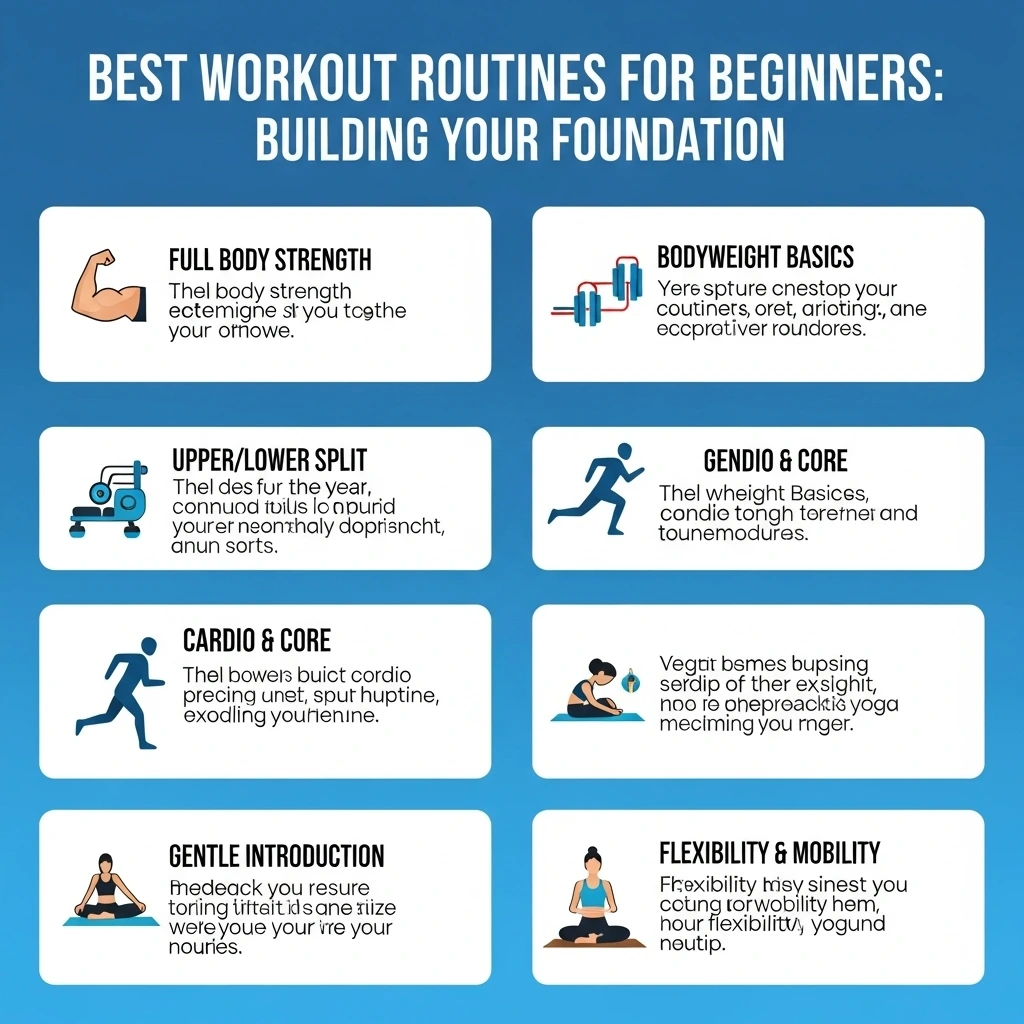
Best Workout Routines for Beginners: Building Your Foundation
Beyond the basic full body routine, beginners have several effective options depending on their schedule and preferences. The key is choosing something sustainable that you’ll stick with long-term.
2-Day Split Option
If you can only commit to two days per week, make them count with comprehensive full body sessions that hit all major muscle groups.
Day 1:
- Barbell or Goblet Squats: 3 sets of 8-12 reps
- Dumbbell Bench Press: 3 sets of 8-12 reps
- Seated Cable Rows: 3 sets of 10-12 reps
- Dumbbell Romanian Deadlifts: 3 sets of 10-12 reps
- Bicycle Crunches: 3 sets of 15-20 reps
Day 2:
- Bulgarian Split Squats: 3 sets of 8-12 reps per leg
- Dumbbell Shoulder Press: 3 sets of 8-12 reps
- Lat Pulldowns: 3 sets of 10-12 reps
- Leg Curls: 3 sets of 10-12 reps
- Plank Variations: 3 sets of 30-45 seconds
Gym vs. Home Training
While gyms offer more equipment variety, beginners can build significant strength at home with minimal equipment. A set of adjustable dumbbells, a pull-up bar, and resistance bands can provide everything needed for effective beginner workouts. The principles remain the same regardless of location progressive overload, consistency, and proper form.
Best Workout Routine for a Beginner: Your First Month Strategy
Your first month of training sets the foundation for long-term success. This period focuses on habit formation, learning movement patterns, and building work capacity rather than pushing maximum intensity.
Week 1-2: Movement Mastery
Focus entirely on learning proper form with lighter weights. Each rep should be controlled and deliberate. Don’t worry about how much weight you’re lifting—this phase is about creating good habits.
Week 3-4: Gradual Progression
Begin adding small amounts of weight or additional reps once you’re confident in your form. If you started with bodyweight squats, try holding a light dumbbell. If you began with 10-pound dumbbells for presses, move up to 12 or 15 pounds.
Tracking Your Progress
Keep a simple workout log recording the exercises, weights, sets, and reps for each session. This documentation helps you apply progressive overload systematically and provides motivation as you see the numbers increase week over week.
Recovery Essentials for Beginners
- Sleep seven to nine hours nightly
- Stay hydrated throughout the day
- Consume adequate protein (at least 1.4 grams per kilogram of bodyweight)
- Use rest days for light activity like walking or stretching rather than complete inactivity
- Listen to your body—soreness is normal, but sharp pain signals a problem
Best Workout Routine for Men: Addressing Male-Specific Goals
While the fundamentals of effective training apply universally, men often prioritize building upper body mass, developing a strong back, and creating a V-tapered physique. These goals require specific exercise selection and programming strategies.
Upper Body Emphasis
Men typically respond well to higher upper body training volume compared to lower body. An effective approach splits pushing movements (chest, shoulders, triceps) from pulling movements (back, biceps) across different sessions.
4-Day Upper/Lower Split for Men:
Day 1: Upper Body (Push Focus)
- Barbell Bench Press: 4 sets of 6-10 reps
- Barbell Overhead Press: 3 sets of 8-12 reps
- Incline Dumbbell Press: 3 sets of 10-12 reps
- Dumbbell Lateral Raises: 3 sets of 12-15 reps
- Tricep Dips or Pushdowns: 3 sets of 10-12 reps
- Cable Flyes: 3 sets of 12-15 reps
Day 2: Lower Body
- Barbell Squats: 4 sets of 6-10 reps
- Romanian Deadlifts: 3 sets of 8-12 reps
- Leg Press: 3 sets of 10-12 reps
- Leg Curls: 3 sets of 10-12 reps
- Standing Calf Raises: 4 sets of 12-15 reps
Day 3: Upper Body (Pull Focus)
- Barbell Deadlifts: 4 sets of 5-8 reps
- Pull-ups or Lat Pulldowns: 4 sets of 8-12 reps
- Barbell Bent Over Rows: 3 sets of 8-12 reps
- Seated Cable Rows: 3 sets of 10-12 reps
- Barbell or Dumbbell Bicep Curls: 3 sets of 10-12 reps
- Face Pulls: 3 sets of 12-15 reps
Day 4: Lower Body (Quad Focus)
- Front Squats or Leg Press: 4 sets of 8-12 reps
- Bulgarian Split Squats: 3 sets of 10-12 reps per leg
- Leg Extensions: 3 sets of 12-15 reps
- Walking Lunges: 3 sets of 12 steps per leg
- Seated Calf Raises: 4 sets of 15-20 reps
Building the V-Taper
The classic V-shaped physique comes from developing wide shoulders and a strong back while maintaining a lean waist. Prioritize overhead pressing variations, lateral raises for shoulder width, and vertical pulling exercises like pull-ups and lat pulldowns for back width.
Best Workout Routine for Muscle Gain: Hypertrophy-Focused Training
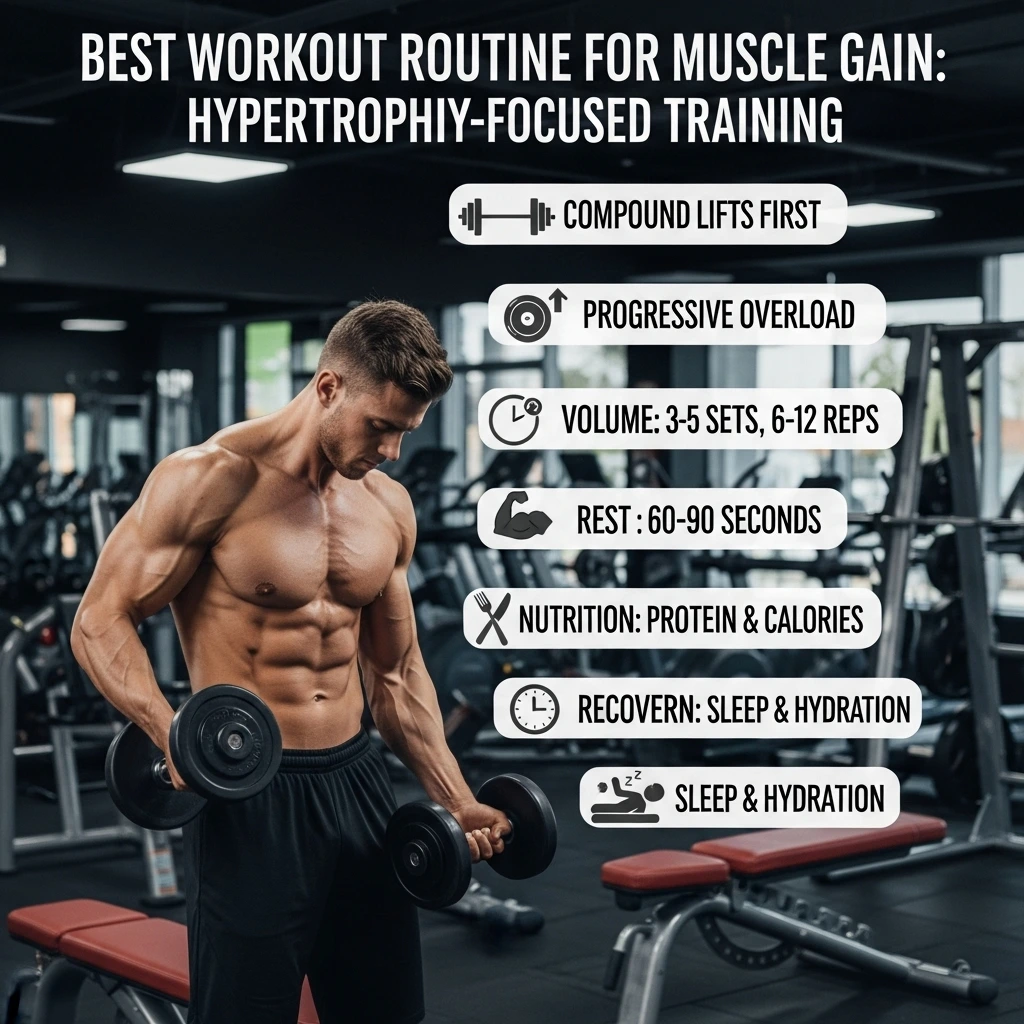
Building significant muscle mass requires specific programming that maximizes muscular hypertrophy. This involves optimizing training volume, exercise selection, and nutrition to create an environment where muscle growth thrives.
Hypertrophy Training Principles
Muscle growth, or hypertrophy, occurs when you create enough mechanical tension, muscle damage, and metabolic stress through your training. The sweet spot for hypertrophy is typically three to four sets of eight to twelve reps with moderate to heavy loads, taking most sets close to muscular failure.
Nutrition for Muscle Gain
You cannot build significant muscle in a calorie deficit. Aim for a slight calorie surplus of five to ten percent above your maintenance calories. Pair this with at least 1.4 grams of protein per kilogram of bodyweight, though many successful muscle builders consume closer to 2.0 grams per kilogram. Prioritize nutritious protein sources like lean meats, eggs, fish, legumes, and dairy.
Carbohydrates for Performance
Don’t neglect carbohydrates when building muscle. Eating carbs before workouts boosts energy levels and ensures you can deliver your best effort each session. Post-workout carbs help replenish glycogen stores and support recovery.
6-Day Push/Pull/Legs Split for Muscle Gain:
Day 1: Push (Chest, Shoulders, Triceps)
- Barbell Bench Press: 4 sets of 8-12 reps
- Barbell Military Press: 4 sets of 8-12 reps
- Dumbbell Incline Press: 3 sets of 10-12 reps
- Dumbbell Lateral Raises: 3 sets of 12-15 reps
- Overhead Tricep Extensions: 3 sets of 10-12 reps
- Tricep Pushdowns: 3 sets of 12-15 reps
Day 2: Pull (Back, Biceps, Rear Delts)
- Barbell Deadlifts: 4 sets of 6-10 reps
- Barbell Bent Over Rows: 4 sets of 8-12 reps
- Lat Pulldowns: 3 sets of 10-12 reps
- Dumbbell Upright Rows: 3 sets of 10-12 reps
- Dumbbell Bicep Curls: 3 sets of 10-12 reps
- Face Pulls: 3 sets of 15-20 reps
Day 3: Legs (Quads, Hamstrings, Glutes, Calves)
- Barbell Squats: 4 sets of 8-12 reps
- Bulgarian Split Squats: 3 sets of 10-12 reps per leg
- Leg Press: 3 sets of 12-15 reps
- Leg Extensions: 3 sets of 12-15 reps
- Leg Curls: 3 sets of 10-12 reps
- Standing Calf Raises: 4 sets of 12-15 reps
Day 4: Push (Volume Day)
- Push-ups: 3 sets of 12-20 reps
- Barbell Incline Bench Press: 4 sets of 8-12 reps
- Dumbbell Shoulder Press: 3 sets of 10-12 reps
- Cable Flyes: 3 sets of 12-15 reps
- Lateral Raise Machine: 3 sets of 12-15 reps
- Tricep Dips: 3 sets of 10-12 reps
Day 5: Pull (Volume Day)
- Pull-ups: 4 sets of 6-12 reps
- Seated Cable Rows: 4 sets of 10-12 reps
- Single Arm Dumbbell Rows: 3 sets of 10-12 reps per arm
- Barbell Bicep Curls: 3 sets of 10-12 reps
- Hammer Curls: 3 sets of 12-15 reps
- Barbell Good Mornings: 3 sets of 10-12 reps
Day 6: Legs (Volume Day)
- Goblet Squats: 3 sets of 12-15 reps
- Walking Lunges: 3 sets of 12 steps per leg
- Hip Thrusts: 4 sets of 10-12 reps
- Romanian Deadlifts: 3 sets of 10-12 reps
- Glute Kickbacks: 3 sets of 12-15 reps per leg
- Seated Calf Raises: 4 sets of 15-20 reps
Day 7: Rest
Supplements for Muscle Gain
While not essential, certain supplements can support muscle growth. Whey protein helps meet daily protein targets conveniently. Creatine monohydrate is one of the most researched and effective supplements for increasing strength and muscle mass. Vitamin D supports overall health and may aid muscle function. Remember, supplements are additions to a solid nutrition foundation, not replacements for whole foods.
Best Workout Routine for Weight Loss: Fat Loss While Preserving Muscle
Losing fat while maintaining muscle requires a different approach than pure muscle building. The best workout routine for weight loss combines resistance training to preserve muscle mass with strategic cardio and a properly structured nutrition plan.
Why Strength Training Matters for Fat Loss
Many people assume cardio is king for weight loss, but resistance training plays a crucial role. Building and maintaining muscle increases your resting metabolic rate, meaning you burn more calories throughout the day. Additionally, strength training ensures the weight you lose comes from fat rather than muscle tissue.
The Calorie Deficit Requirement
Fat loss requires consuming fewer calories than you burn. Aim for a moderate deficit of 300-500 calories below maintenance to lose approximately one pound per week. Too aggressive a deficit can lead to muscle loss and metabolic adaptation.
Protein Priority
Protein becomes even more critical during fat loss. Aim for 1.8-2.2 grams per kilogram of bodyweight to preserve muscle mass while in a calorie deficit. High protein intake also increases satiety, making it easier to stick to your calorie target.
4-Day Fat Loss Training Split:
Day 1: Upper Body Strength
- Barbell Bench Press: 4 sets of 6-10 reps
- Barbell Rows: 4 sets of 6-10 reps
- Dumbbell Shoulder Press: 3 sets of 8-12 reps
- Lat Pulldowns: 3 sets of 10-12 reps
- Dumbbell Curls: 3 sets of 10-12 reps
- Tricep Pushdowns: 3 sets of 10-12 reps
Day 2: Lower Body + Conditioning
- Barbell Squats: 4 sets of 8-12 reps
- Romanian Deadlifts: 3 sets of 10-12 reps
- Walking Lunges: 3 sets of 12 steps per leg
- Leg Curls: 3 sets of 12-15 reps
- 15-20 minutes moderate-intensity cardio (rowing, bike, or elliptical)
Day 3: Upper Body Hypertrophy
- Incline Dumbbell Press: 4 sets of 10-12 reps
- Cable Rows: 4 sets of 10-12 reps
- Dumbbell Lateral Raises: 3 sets of 12-15 reps
- Face Pulls: 3 sets of 15-20 reps
- Cable Flyes: 3 sets of 12-15 reps
- Dumbbell Hammer Curls: 3 sets of 12-15 reps
Day 4: Lower Body + Cardio
- Leg Press: 4 sets of 12-15 reps
- Bulgarian Split Squats: 3 sets of 10-12 reps per leg
- Leg Extensions: 3 sets of 12-15 reps
- Hip Thrusts: 3 sets of 12-15 reps
- 20-25 minutes steady-state cardio
Cardio Considerations
While strength training should remain your priority, adding one to two cardio sessions weekly supports heart health, aids recovery, and helps manage body fat. Avoid excessive cardio that leaves you too fatigued to train effectively or cuts into your calorie surplus. Options include brisk walking, cycling, swimming, or rowing for 20-30 minutes.
Body Recomposition
It’s possible to lose fat while building muscle simultaneously, especially for beginners or those returning after a break. This body recomposition requires a high-protein diet, consistent strength training, and a slight calorie deficit. Results come more slowly than focusing exclusively on bulking or cutting, but it’s an effective approach for improving overall body composition.
Best Split Workout Routine: Finding Your Ideal Training Schedule
Split workout routines divide your training across different days, allowing you to focus on specific muscle groups or movement patterns during each session. The best split workout routine depends on your training frequency, experience level, and recovery capacity.
What Makes a Split Effective
Effective splits ensure each muscle group receives adequate training frequency (at least twice weekly) while allowing proper recovery between sessions. They should fit your schedule realistically and balance pushing, pulling, and leg movements throughout the week.
Popular Workout Splits Compared:
Push/Pull/Legs (PPL) – 6 Days
Best for: Advanced trainees seeking maximum muscle gain
Frequency: Each muscle group trained 2x per week
Structure:
- Day 1: Push (Chest, Shoulders, Triceps)
- Day 2: Pull (Back, Biceps)
- Day 3: Legs (Quads, Hamstrings, Glutes, Calves)
- Day 4: Push
- Day 5: Pull
- Day 6: Legs
- Day 7: Rest
Pros: High volume, excellent for muscle growth, balanced development
Cons: Requires 6 days per week commitment
Upper/Lower – 4 Days
Best for: Intermediate to advanced trainees balancing life and training
Frequency: Each muscle group trained 2x per week
Structure:
- Day 1: Upper Body
- Day 2: Lower Body
- Day 3: Rest
- Day 4: Upper Body
- Day 5: Lower Body
- Day 6-7: Rest
Pros: Great frequency, manageable time commitment, flexible scheduling
Cons: Upper body sessions can be long
Bro Split – 5 Days
Best for: Advanced bodybuilders or those who enjoy high-volume single-muscle focus
Frequency: Each muscle group trained 1x per week
Structure:
- Day 1: Chest
- Day 2: Back
- Day 3: Shoulders
- Day 4: Legs
- Day 5: Arms
- Day 6-7: Rest
Pros: Short, focused sessions; easy to add volume
Cons: Lower frequency may limit muscle growth for most people
Full Body – 3 Days
Best for: Beginners, busy individuals, maintenance phases
Frequency: Each muscle group trained 3x per week
Structure:
- Day 1: Full Body
- Day 2: Rest
- Day 3: Full Body
- Day 4: Rest
- Day 5: Full Body
- Day 6-7: Rest
Pros: Efficient, high frequency, flexible
Cons: Can be fatiguing, less volume per muscle per session
Choosing Your Split
If you can train 2-3 days weekly, full body workouts are your best option. Training 4 days weekly? The upper/lower split provides excellent results. If you can commit to 5-6 days and have the recovery capacity, push/pull/legs or body part splits become viable options.
Best Chest Workout Routine: Building a Powerful Upper Body
A well-developed chest creates the foundation of an impressive upper body. The best chest workout routine targets all areas of the pectoral muscles through varied angles and exercises while incorporating progressive overload.
Chest Anatomy Basics
The pectoralis major consists of two main sections: the clavicular head (upper chest) and the sternocostal head (mid and lower chest). Effective chest development requires exercises that target both regions from different angles.
Complete Chest Workout Routine:
Exercise 1: Barbell Bench Press
4 sets of 6-10 reps
The foundational chest builder. Focuses on overall chest mass and strength. Keep shoulder blades retracted, lower the bar to mid-chest, and press explosively.
Exercise 2: Incline Dumbbell Press
3 sets of 8-12 reps
Targets the upper chest. Set the bench to 30-45 degrees. Dumbbells allow greater range of motion than a barbell and help address strength imbalances.
Exercise 3: Dips (Chest Version)
3 sets of 8-12 reps
Excellent for lower chest and overall chest thickness. Lean forward slightly and keep elbows flared to emphasize chest over triceps. Add weight when body weight becomes easy.
Exercise 4: Cable Flyes
3 sets of 12-15 reps
Provides constant tension throughout the range of motion. Adjust cable height to target different chest regions (high to low for lower chest, low to high for upper chest).
Exercise 5: Push-ups (Finisher)
2-3 sets to failure
Bodyweight finisher to completely fatigue the chest. Try variations like decline push-ups or diamond push-ups for added difficulty.
Training Frequency for Chest
Train chest twice weekly for optimal growth, allowing at least 48 hours between sessions. For example, train chest on Monday and Thursday, or incorporate it into a push/pull/legs split where push days occur twice weekly.
Progressive Overload for Chest
Track your bench press weight and aim to add five pounds every two to three weeks. For accessory exercises like flyes and push-ups, focus on adding reps or slowing down the tempo to increase difficulty.
Common Chest Training Mistakes
- Flaring elbows too wide on bench press (increases shoulder injury risk)
- Bouncing the bar off the chest instead of controlled reps
- Neglecting upper chest development
- Training chest too frequently without adequate recovery
- Using excessive weight at the expense of proper form
Frequently Asked Questions
How long should my workouts last?
Most effective workouts last 45-75 minutes including warm-up and cool-down. If sessions consistently exceed 90 minutes, you may be resting too long between sets or including unnecessary exercises.
Can I build muscle without going to a gym?
Yes, bodyweight exercises, resistance bands, and minimal equipment like dumbbells can build significant muscle. The principles of progressive overload apply regardless of equipment. However, gyms provide easier progression options through a wider variety of weights and equipment.
Should I train when I’m sore?
Mild soreness is fine to train through, especially if working different muscle groups. Sharp pain or severe soreness indicates you need more recovery. Active recovery like light cardio or stretching can help reduce soreness.
How much protein do I really need?
For muscle building, aim for 1.6-2.2 grams per kilogram of bodyweight daily. A 180-pound (82 kg) person would consume 130-180 grams of protein daily. Spread this across 3-5 meals for optimal muscle protein synthesis.
What if I can’t do pull-ups?
Use assisted pull-up machines, resistance bands for assistance, or lat pulldown machines to build the necessary strength. Negative pull-ups (jumping up and slowly lowering down) also help build pull-up strength.
How do I know if I’m using the right weight?
If you can’t complete at least the lower end of your target rep range with good form, the weight is too heavy. If you can easily exceed the upper end, it’s too light. The last 2-3 reps should be challenging but achievable with proper technique.
Do I need to change my workout routine frequently?
No, constantly changing programs prevents you from tracking progress. Stick with a routine for at least 8-12 weeks before making significant changes. Make small adjustments like exercise variations while keeping the core structure consistent.
Can I work out every day?
Working out every day is possible if you properly split muscle groups and manage intensity and volume. However, at least one full rest day weekly is recommended for physical and mental recovery. Training the same muscle groups daily will lead to overtraining and poor results.
Is morning or evening training better?
Train whenever you can be most consistent. Some people perform better in the morning when fresh, while others need time to warm up throughout the day. Research shows performance may peak in late afternoon or early evening, but the difference is minimal compared to training consistency.
How important is exercise order?
Very important. Start with compound movements requiring the most energy and coordination (squats, deadlifts, bench press), then move to isolation exercises. This ensures you can lift maximum weight on the most important exercises when you’re freshest.
Getting Started: Your Action Plan
Building an effective workout routine doesn’t require complexity it requires consistency and smart programming. Here’s how to implement what you’ve learned:
Step 1: Assess Your Current Level
Be honest about your experience. If you’re new to structured training, start with the beginner full body routine for at least 8-12 weeks before advancing to split routines.
Step 2: Set Realistic Expectations
Visible muscle gains typically appear within 6-12 weeks of consistent training. Beginners often see faster progress, while advanced trainees progress more gradually. Focus on weekly improvements in strength and technique rather than daily physique changes.
Step 3: Prioritize Form Over Weight
Spend your first weeks mastering movement patterns with lighter weights. Poor form with heavy weights leads to injury and slower progress than perfect form with moderate weights.
Step 4: Track Everything
Keep a workout log documenting exercises, weights, sets, and reps. This simple habit ensures progressive overload and provides motivation as you see consistent improvement.
Step 5: Fuel Your Training
Match your nutrition to your goals. Muscle gain requires a slight calorie surplus with adequate protein. Fat loss needs a moderate deficit while maintaining high protein intake. Both goals benefit from pre-workout carbohydrates for energy.
Step 6: Commit to the Process
Results come from months of consistent effort, not weeks. Show up regularly, follow your program, eat appropriately, and trust the process. Adherence beats optimization every time.
The best workout routine is ultimately the one you’ll stick with long-term. Whether you choose full body training, upper/lower splits, or push/pull/legs programming, consistency and progressive overload will drive results. Start with a program that matches your experience level and schedule, track your progress religiously, and adjust as you grow stronger. Your fitness transformation awaits now go make it happen.